
-
Latest Issue
This Special Edition of the Benz Bulletin is prompted by recent articles about Chinese ownership of Mercedes-Benz and the risk that the company could be shut out of the US market under new bipartisan legislation.
Top News
1
Legislative proposals would ban Mercedes-Benz due to Chinese ownership
Mercedes-Benz could be shut out of the U.S. market under proposed legislation advancing in the U.S. House of Representatives.
The Vehicle Modernization Act of 2026 prohibits companies controlled by “foreign adversary countries,” including China, from selling and producing vehicles in the U.S. Multiple outlets, including CNBC, Bloomberg, and Yahoo Finance, have reported that Mercedes would be impacted if the legislation were to pass. The company’s largest shareholder is BAIC, with a 9.98% stake in total capital. BAIC is a state-owned Chinese automaker and Mercedes’ joint venture partner in China. Its second-largest shareholder is Li Shufu, the chairman of the Chinese automaker Geely. He owns 9.69%, bringing the Chinese combined total to 19.67%. The bill defines corporate control as owning at least 15% of equity.
While the bill contains an exemption for companies that already sell and produce in the US, the exemption does not apply to companies with equity stakes held directly by state-owned enterprises of listed foreign adversaries. BAIC is owned by the People’s Republic of China.
Legislation has been introduced in the U.S. Senate as well, which also includes the 15% ownership threshold, but does not specify if and when a company may be exempted.
2
There is mounting political, industry, and popular support for the legislation
Legislative support for the bills is broad and bipartisan.
Industry support for banning Chinese market access encompasses organized labor, major automakers, and dealers. Reuters reported in March that the Alliance for Automotive Innovation, the National Automobile Dealers Association, Autos Drive America, the American Automotive Policy Council, and MEMA, the Vehicle Suppliers Association, all urged the administration to keep Chinese automakers out of the U.S. market.
The legislation comes at a time of broad distrust of China across the US. In Pew’s 2026 American Trends survey, 71% of Americans reported having an unfavorable opinion of China. In addition, 60% of consumers do not support Chinese automotive brands entering the U.S. market, and most do not trust that they would comply with U.S. regulations. Unfavorable perceptions of China as a U.S. competitor cut across both parties, implying durable support for continued restrictions on Chinese market access.
Distrust is even higher among dealers. According to one survey, 68% of dealers are very or somewhat concerned about Chinese automakers entering the U.S. market, while another survey found that 92% are concerned about selling Chinese-brand vehicles.
3
Chinese ownership and tech are a brand risk
Mercedes’ Chinese ownership is not new: BAIC acquired its stake in 2019, and Li Shufu in 2018. But recent news stories bring attention to the company’s ownership at a particularly low moment in U.S.-China relations. Not only do Americans view China overall in an unfavorable light, but American consumers are also highly skeptical of Chinese-made cars.
In recent surveys from Cox Automotive and the Harris Poll, a minority of consumers say they would consider buying a Chinese vehicle. Consumers’ reluctance is mainly due to negative perceptions related to quality and security, with 39% of noting concerns about the quality of Chinese cars.
The company’s increasing integration of Chinese components and technology could also ultimately affect perceptions of Mercedes’ premium brand. In one survey, Mercedes-Benz boasted a high favorability among consumers, with 76% holding a favorable view of the brand. By contrast, Chinese car brands were panned, with 54% saying they were viewed mostly unfavorably.
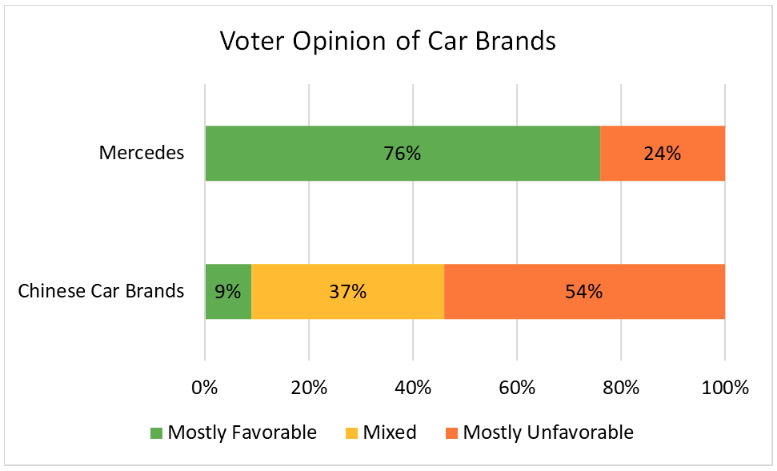
Source: EVs for All Americans, Fixing America’s Partisan Divide Over EVs, 1/12/2026 In the last year, Mercedes has rolled out multiple models with Chinese content ranging from 10% to 33% of total vehicle value, despite being assembled in the U.S. and Germany. Mercedes is also increasing R&D activity in China and has made clear its desire to bring technologies developed in China to markets globally.
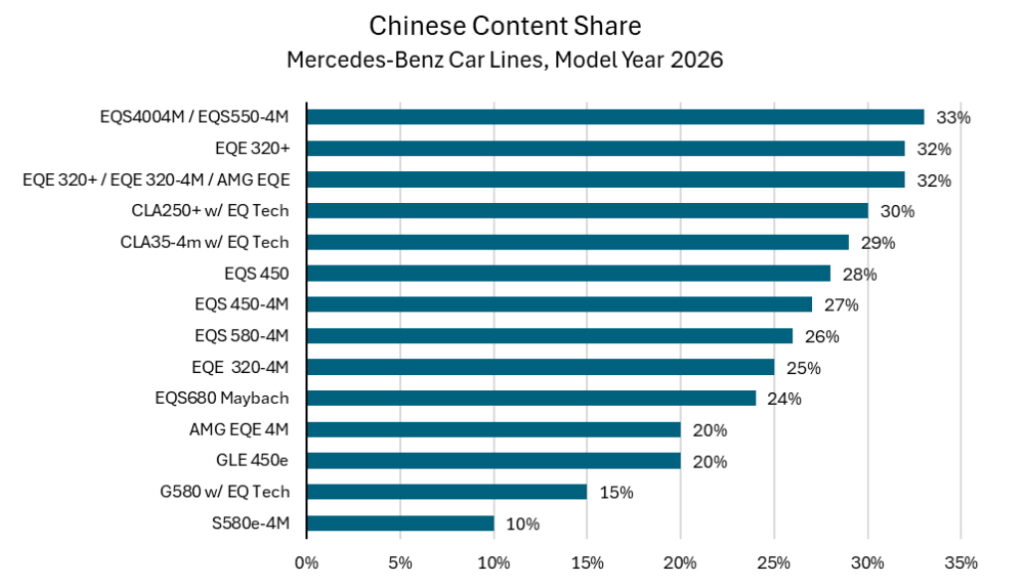
Source: U.S. National Highway Traffic Safety Administration, Part 583 American Automobile Labeling Act Report, MY2026. For example, the engine for Mercedes’ 2026 hybrid CLA 220 was developed in collaboration with Geely, which manufactures the engines in China. Mercedes is also considering using Geely’s architecture for its new EV platform.
Integration of Chinese in-vehicle technology is also a liability for consumers anxious about data privacy and surveillance. In one survey, 79% of respondents expressed concerns about the possible national security risks of Chinese cars.
Headlines such as “The New CLA Hybrid Isn’t As German As Mercedes Wants You To Think” are likely to become more common as the company deepens its integration with the Chinese auto industry and as consumers and lawmakers more closely scrutinize the trend.
To help dealers, customers, policymakers, and other stakeholders stay informed about key developments at Mercedes-Benz, we will soon be publishing a regular newsletter titled Benz Bulletin.
This publication will track important corporate, labor, and ESG-related news about the company worldwide.
Subscribers get concise, verified updates to promote transparency across the Mercedes network. Sign up here for early access.
Past Issues
-
Issue 2
Top News 1 Bipartisan Push to Restrict Chinese Autos in U.S. Gains Steam With Chinese auto exports continuing to surge, newly proposed bipartisan legislation aims to codify regulations keeping Chinese vehicles off U.S. roads. The Connected Vehicle Security Act of 2026, cosponsored by Senators Moreno (R-Ohio) and Slotkin (D-Michigan), expands on a Biden-era Commerce Department…
-
Issue 1
Top News 1 Mercedes CEO at Beijing Auto Show: “Ich bin Chinese” Echoing President John F. Kennedy, Mercedes CEO, Ola Källenius, declared the company’s commitment to China at the 2025 Beijing Auto Show: “Ich bin Chinese. I only look European. Because what we are developing here, I want too.” Källenius has made no secret of his admiration for the…