Top News
1
Mercedes CEO at Beijing Auto Show: “Ich bin Chinese”
Echoing President John F. Kennedy, Mercedes CEO, Ola Källenius, declared the company’s commitment to China at the 2025 Beijing Auto Show: “Ich bin Chinese. I only look European. Because what we are developing here, I want too.”
Källenius has made no secret of his admiration for the country and its auto sector. Mercedes’ performance is also tightly linked with its ability to revive its business in China’s hyper-competitive market. In 2025, the company sold 571,938 vehicles to Chinese customers, making it Mercedes’ largest national market by a wide margin. Annual sales exceeded those in both the U.S. and Germany by 200,000 units. Vehicle exports to China brought in €16.5 billion, or 12% of total revenue, and profits from Mercedes’ Chinese joint venture, Beijing Benz, accounted for 13% of pre-tax earnings. Indicative of China’s importance to the company’s future, the company opened an R&D center in Shanghai in 2022, and two years later, expanded the facility to lead work on Mercedes’ intelligent and autonomous vehicle technology. It foresees eventually bringing this technology to global markets.
2
Benz Busted Again: $150M Settlement Over Mercedes-Benz Reaches $150M Settlement Over Diesel Emissions-Cheating Software Emissions-Cheating Software
Mercedes just agreed to pay $149.7 million to a coalition of 50 state/territory attorneys general after investigators said the company used undisclosed “defeat device” software in diesel vehicles to ace emissions tests — and then blow past legal limits in real-world driving (in some cases 30–40x the limit). The same vehicles were marketed as “clean/green” and “ultra-low emissions.” The deal includes $2,000 payments for eligible owners/lessees who get the approved emissions fix. It’s also the latest chapter in a saga Mercedes has been paying for since at least 2020, when it settled related U.S. diesel claims for $2.2 billion.
Meanwhile across the Atlantic, Mercedes is also one of several automakers facing a major UK High Court trial tied to “dieselgate”-era allegations, with about 1.6 million claimants in what’s described as one of the biggest mass claims in English legal history. That case is testing sample vehicles first, and if the court finds unlawful defeat devices, a follow-on damages phase is slated for 2026 (with total claims in the broader litigation estimated around £6 billion).
3
UAW Reaches Contract with Volkswagen While Mercedes-Benz Agrees to Settlement with Labor Board
n a historic victory, Volkswagen workers have voted by 96 percent to ratify their first union contract at Volkswagen’s Chattanooga assembly plant. The deal locks in 20 percent wage increases, healthcare cost reductions, job security guarantees, an enforceable grievance procedure, and much more. The ratification vote caps a years-long campaign by Volkswagen Chattanooga autoworkers to join the UAW and win a better life with a union contract.
While Volkswagen is taking the high road, Mercedes-Benz is going low. According to a report by Bloomberg, Mercedes has settled a case with the National Labor Relations Board over alleged union busting at its Vance, AL assembly plant. As part of the settlement, Mercedes agreed to revoke discipline it had issued to one employee. The company also agreed not to threaten employees with loss of benefits if they unionize, “unlawfully surveil or interrogate” them about distributing union materials in non-work areas during their breaks or otherwise “interfere with, restrain, or coerce” employees from exercising their organizing rights. To learn more about Mercedes’ anti-union practices, check out Mercedes Benz Takes the Low Road How Mercedes Is Breaking the Law & Violating Its Own Principles in the U.S. And How to Get the Company Back on Track.
4
Smooth Financing, but Costly Upkeep and Unsatisfied Customers?
Mercedes-Benz Financial Services ranked #1 among captive lenders in J.D. Power’s 2025 U.S. Automotive Finance Digital Experience Study, reflecting a strong online and mobile financing experience. But Consumer Reports’ reader-reported data highlights a different reality over time—Mercedes is among the most expensive brands to maintain, averaging $12,630 over 10 years ($3,330 in years 1–5 and $9,300 in years 6–10) in out-of-pocket maintenance and repair costs (excluding collision). Similarly, J.D Power 2026’s U.S. Customer Service Index (CSI) Study ranked Mercedes-Benz near the bottom in customer satisfaction among premium brands.
5
Economist Warns Mercedes Could Look Very Different by 2030
In a roundtable on the future of Germany’s auto sector, economist Moritz Schularick (president of the Kiel Institute for the World Economy) said the German “big three” — Mercedes-Benz, BMW, and Volkswagen — “probably won’t exist in their current form by the end of the decade” given the industry’s current trajectory. He floated what he called a “Volvo solution”: bringing in a strategic investor to stabilize and reposition the companies, potentially including a Chinese investor that could provide technology and new-market access. The takeaway isn’t that Mercedes disappears overnight, but that even mainstream economic voices are now openly discussing scenarios where the brand’s future involves major restructuring.
6
The New CLA Hybrid: Built in Hungary, Powered by China?
As part of Mercedes reported strategy of focusing on lower-margin high-volume vehicles, the company launched the all-new CLA hybrid in late 2025 in the US with the EV version coming soon. But here’s a wrinkle, according to CarScoops, the CLA hybrid “uses an engine that’s not from Mercedes, but rather is being sourced from China.”
“Yes, your next German car might just come with a Chinese heart… Mercedes says it ‘developed’ this new engine, though what it doesn’t openly advertise is that it was co-developed with Geely. According to reporting by China’s IThome, the engine won’t just be designed with Chinese input, it will also be built in China, then shipped to Mercedes for integration.”
In addition, Mercedes is no longer building the CLA in Germany. According to Automotive News Europe, the company is “moving production of its entry-level A-Class from Germany to Hungary, a decision driven largely by cost savings and manufacturing efficiency. From the second quarter, the compact model will be built at Mercedes’ plant in Kecskemet, 100 km southeast of Budapest, freeing up space in the Rastatt factory in Germany.”
Litigation Corner
On February 11, 2026, a group of workers filed a class action case in federal court in Alabama alleging that Mercedes-Benz U.S. International (MBUSI), Inc. failed to (1) properly include non-discretionary bonuses in the regular rate of pay, (2) compensate for “off-the-clock” work performed during meal breaks, and (3) compensate for time spent donning and doffing personal protective at the company’s Vance, AL assembly plant. MBUSI denies the allegations. On March 30, 2026, the company opposed a motion providing notice of the lawsuit to the more than 5,000 workers at the Vance facility arguing it would “confuse” workers and “impact productivity and irreversibly damage morale and trust.”
In 2024, the U.S. Department of Labor found MBUSI “illegally fired two production workers after they requested to use FMLA-protected leave” and recovered $438,625 in back wages, unpaid bonuses, equitable remedy and liquidated damages from the company.
Quick Hits
- Mercedes investors warn luxury focus could hamper China recovery, Reuters, 4/16/2026
- Why BMW, Mercedes are pulling back on eyes-off self-driving in favor of Tesla-style systems, Automotive News Europe, 4/19/2026
- What’s Going On at Mercedes-Benz?, MotorTrend, 4/14/2026
- Mercedes-Benz secures multi-year EV battery supply deal with Samsung SDI, WardsAuto, 4/21/2026
- Mercedes Wants ‘Exploding’ Sunroof Lawsuit Thrown Out—But the Case Isn’t Over, Autoblog, 4/12/2026
- Mercedes Eyeing a Lawsuit Against the US Government, Newsweek, 4/1/2026
Wall Street Whispers
According to a 3/23/2026 report by Bloomberg Intelligence, “[a]utomotive net cash at Volkswagen, BMW and Mercedes-Benz now exceeds half their market capitalizations, highlighting how EV-transition uncertainty, pricing pressure and softer demand continue to weigh.
Liquidity remains strong enough to support shareholder returns, but cash buffers also help manage geopolitical risk and fund restructuring. Payouts may stay constrained while German labor talks continue over wage cuts and plant closures.
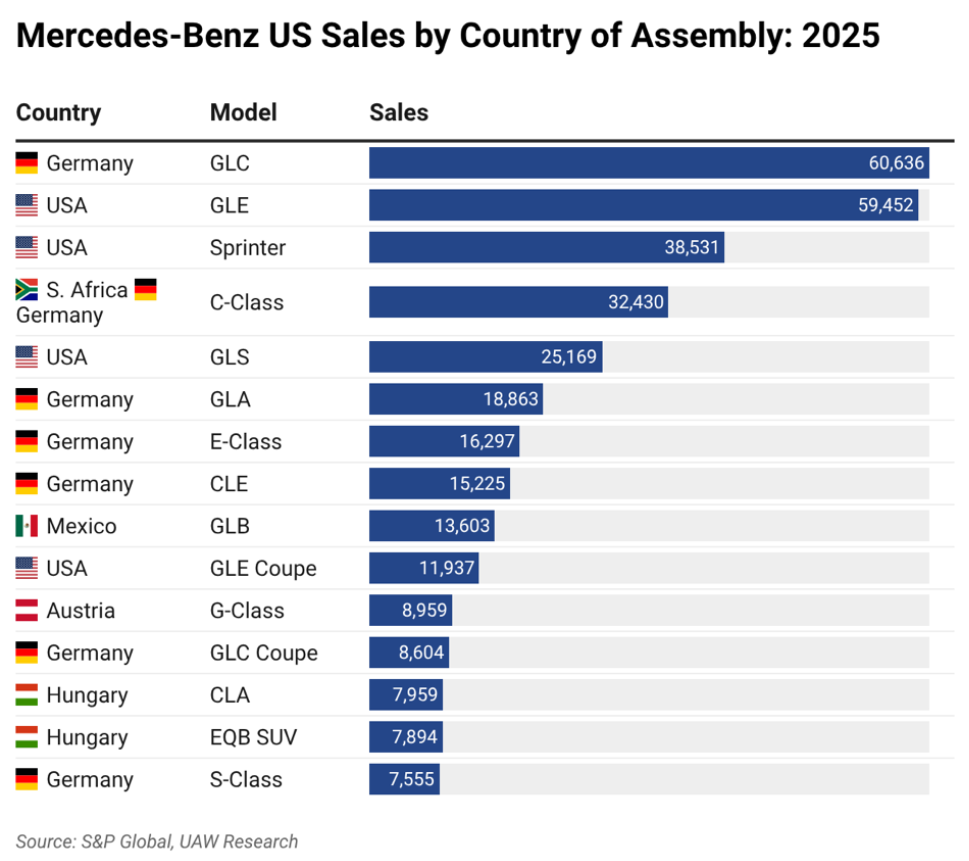
Datapoint #1: Where is My Mercedes Built?
According to Morningstar, “[a]round half of Mercedes’ US sales are assembled locally; however, the proportion of locally sourced content in these vehicles is very low, meaning a large portion of imported auto parts will still attract tariffs.” Where are Mercedes’ top US sellers assembled?