Top News
1
Bipartisan Push to Restrict Chinese Autos in U.S. Gains Steam
With Chinese auto exports continuing to surge, newly proposed bipartisan legislation aims to codify regulations keeping Chinese vehicles off U.S. roads. The Connected Vehicle Security Act of 2026, cosponsored by Senators Moreno (R-Ohio) and Slotkin (D-Michigan), expands on a Biden-era Commerce Department regulation banning Chinese companies from selling connected vehicles and their associated components in the U.S. on national security grounds. It also covers companies in which Chinese entities hold more than 15% of equity or a controlling stake. The UAW has endorsed this legislation.
The senators argue that such vehicles, equipped as they are with cameras, sensors, and geolocation devices, can be used to surveil U.S. drivers and collect sensitive information. The ubiquity of connected vehicle technology effectively means the bill would act as a total ban, although it does create an appeals process by which companies could apply for a Commerce Department waiver.
Beyond their security concerns, lawmakers also fear that competition from Chinese automakers could lead to the loss of both jobs and industrial capacity in the U.S. auto sector. Seventy members of the U.S. House of Representatives sent an open letter to President Trump supporting restrictions on Chinese automakers’ access to the U.S. market, citing their exploitative labor practices and dumping of exports at government-subsidized prices. Bipartisan companion legislation to the Connected Vehicle Security Act is also now making its way through the U.S. House. The U.S. has imposed a 100% tariff on imported Chinese electric vehicles since 2024.
2
First Quarter Results Show Worsening Struggles in China
Mercedes-Benz’s first quarterly results of 2026 paint a picture of a company facing significant headwinds across multiple markets as it undertakes a massive 40-model launch plan. Unit sales, revenue, earnings before interest and taxes, and cash flow were all down year-on-year.
Behind its sagging top-line figures was ongoing deterioration in China, Mercedes’ largest market by a wide margin. Car sales dropped 27% and 86% in Vans. This continues a four-year accelerating decline in Chinese sales volume. German brands have been among the hardest hit by rapid electrification and intensifying competition in China. As the head of Volkswagen in China quipped, “…some younger customers perceive us as the brand for the parents.” In response, Mercedes is refreshing and expanding its portfolio in China to keep pace with consumers’ high and rising expectations for in-vehicle tech integration.
The two dim bright spots in the company’s results were Europe and North America, where sales in the Cars segment increased by 7% and 16%, respectively, from the start of last year. New EV offerings in particular buoyed its European business, accounting for 41% of regional sales. Mercedes still expects to maintain annual revenue and significantly boost annual earnings for 2026 by controlling costs and cutting back on R&D and capital expenditures. These results, however, were delivered before Pres. Trump threatened to raise tariffs on cars imported from the EU, the costs of which, according to the German auto association VDA, would be “enormous.” In 2025, Mercedes exported 156,000 vehicles to the U.S. from Europe.
3
Smart Auto Hoping for Possible U.S. Return
At the 2026 Beijing Auto Show, executives of Smart Auto emphasized their desire to see the brand revived in the U.S., sharing that they would “love to go back.” Smart’s distinctive city cars were sold in the U.S. between 2008 and 2019, but were discontinued after failing to gain much traction.
They also acknowledged, though, that the company faces a much more forbidding geopolitical landscape given changes in the company’s ownership and production network. Formerly a Daimler subsidiary, Smart is today a 50-50 joint venture between Mercedes and the Chinese automaker, Geely. All of Smart’s current models are based on Geely architecture and assembled in China. Executives’ desire to reenter the U.S. market may stem from the brand’s collapse elsewhere in recent years: Between 2023 and 2025, annual sales plummeted from 18,054 to just 40.
4
Mercedes Announces Investment in U.S. GLC SUV Production (Again)
Mercedes is investing $4 billion over the remainder of the decade at its U.S. assembly plant in Alabama to prepare the facility for production of the next-generation GLC SUV. At the company’s announcement event in Tuscaloosa, top executives were joined by the state’s governor, both of the state’s U.S. senators, and U.S. Transportation Secretary Sean Duffy.
Despite the fanfare, Mercedes made its intention to bring the GLC SUV from Germany to Alabama known over a year ago. In fact, the company originally expected to start production next year, but it now anticipates the model’s launch could be delayed another year or two. It hasn’t yet specified a timeline. And even as Mercedes expands its production lineup in Alabama, industry analysts at S&P Global forecast that actual output will nevertheless remain depressed through 2030 and well below its previous peak in 2023.
5
YouGov Consumer Survey Reveals Mercedes’ Brand Perception in the U.S.
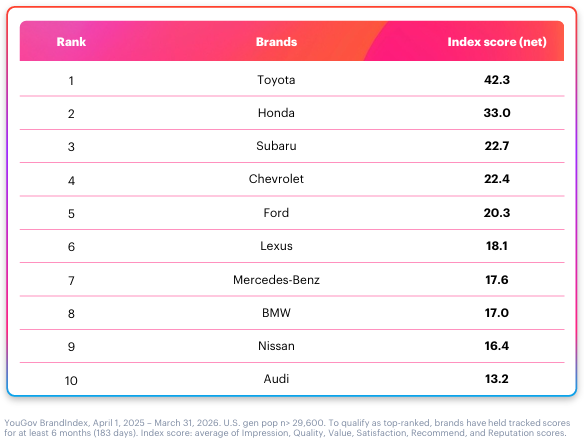
Mercedes-Benz is a Top 10 auto brand in the U.S. according to YouGov’s U.S. automotive rankings 2026. The survey polled nearly 30,000 respondents to produce an index of consumers’ overall brand perception across multiple dimensions. Mercedes ranked seventh, behind major Japanese brands and mainstays of the U.S. market, Chevrolet and Ford. The survey also revealed demographic variation in the company’s brand perception. Men assess Mercedes cars more positively than women, as do car buyers under the age of 30. Those between 40 and 60 years of age generally have a more negative view of the brand. The company ranked ninth in net satisfaction among current and former owners, with 61.9% reporting satisfaction with their purchase decision.
6
U.S. Recall Issued Over Display Failure
The U.S. National Highway Traffic Safety Administration (NHTSA) announced that Mercedes is recalling over 144,000 vehicles due to issues related to their infotainment system. Affected models include the 2024-26 AMG GT, C-Class, E-Class, SL, CLE, and GLC. NHTSA’s investigation found that all of these models were at risk of a software failure that can cause the digital instrument cluster’s display to temporarily go blank without warning while the vehicle is in motion. Owners are instructed to bring covered vehicles to an authorized dealership to receive a software update for the infotainment control unit.
Litigation Corner
Mercedes-Benz USA settled a class action lawsuit over allegations it failed to cover emissions-related parts under its California emissions warranty. The settlement terms allow class members to claim reimbursements for repairs and diagnoses related to high-cost emissions parts and ongoing reimbursements for repairs and replacements between the expiration of their vehicle’s 4-year/50,000-mile warranty and its 7-year/70,000-mile warranty. Eligible class members are those who purchased or leased a Mercedes vehicle, model year 2015 or later, that paid to diagnose, repair, or replace covered parts and whose vehicle is registered in California or one of 16 other U.S. states that have also implemented California’s emissions regulations under Section 177 of the federal Clean Air Act. Mercedes denies any factual allegations or charges of wrongdoing asserted by the plaintiffs in the course of the litigation.
Quick Hits
- Demand for Mercedes-Benz S-Class flagship model picks up, head of production says, Reuters,4/30/2026
- Mercedes inks deal with BNP to sell leasing business, Reuters, 4/29/2026
- Mercedes and VW challenge FCA motor finance compensation scheme, Financial Times, 4/29/2026
- Mercedes-Benz taps Liquid AI for on-device in-car AI, Automotive World, 4/23/2026
- Seres joins BMW, Mercedes-Benz in Ionchi charging JV, Automotive World,4/22/2026
Wall Street Whispers
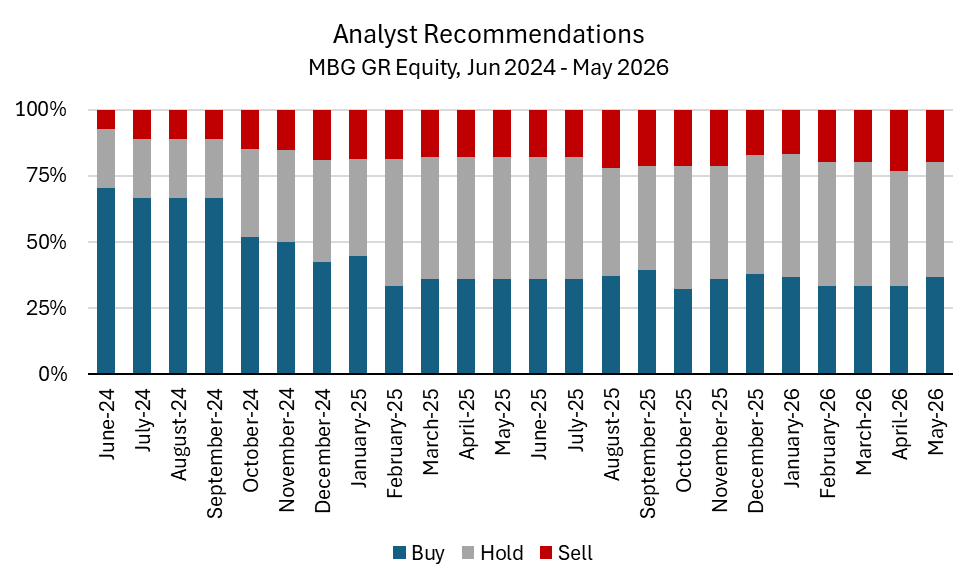
In the latter half of 2024, Wall Street analysts turned decidedly bearish on Mercedes-Benz stock. The share recommending “buy” fell from 70% in June 2024 to 36% in March 2025, where it’s more-or-less hovered ever since. A plurality of analysts now recommends investors maintain their position, and another fifth are counseling them to sell.
Datapoint #1
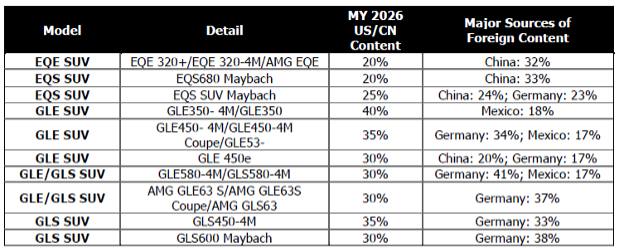
Higher tariffs on EU vehicle imports are likely to dent Mercedes’ bottom line. But the U.S. Trade Representative’s Section 301 investigation weighing higher levies on a broader set of countries and goods, including auto parts, also stands to increase production costs for the company’s domestically assembled vehicles. Most models source more of their content from Germany and China than they do the U.S. and Canada.
Datapoint #2
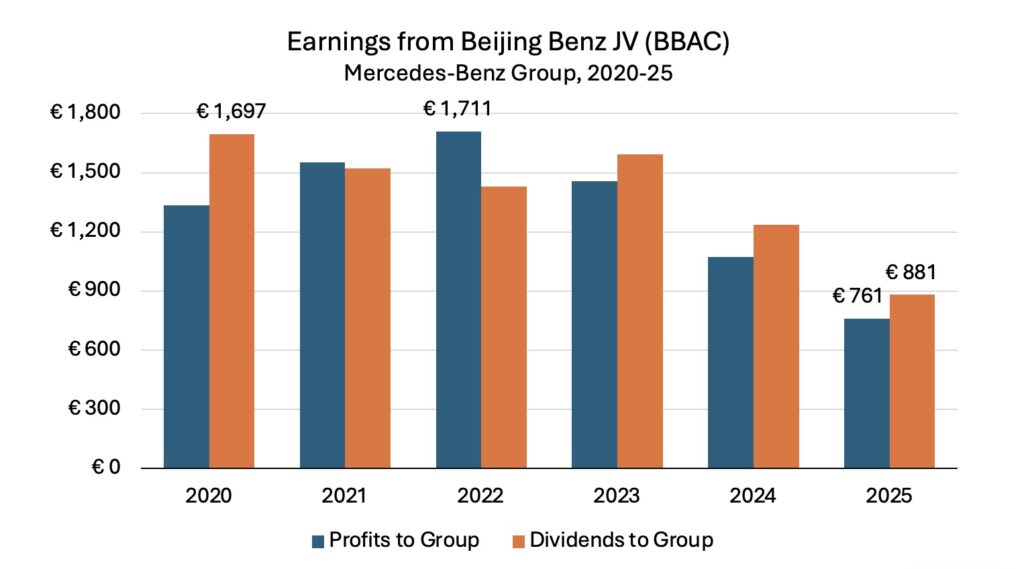
As evidence of Mercedes’ mounting struggles in China, 2025 profits and dividends from its joint venture with BAIC Motor, Beijing Benz, collapsed to just half their previous peak levels over the last six years